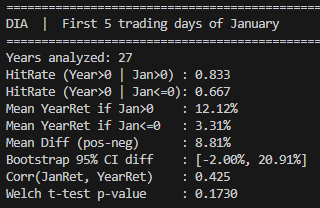
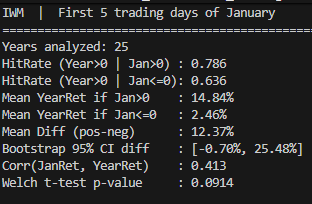
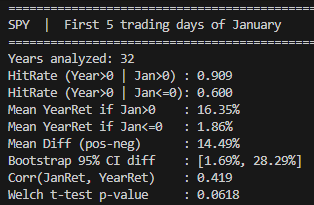
import yfinance as yf
import pandas as pd
import numpy as np
import matplotlib
matplotlib.use("Agg")

import matplotlib.pyplot as plt
import seaborn as sns
import os

# Optional (für p-value / regression)
try:
    from scipy import stats
    HAS_SCIPY = True
except Exception:
    HAS_SCIPY = False


TICKERS = ["QQQ", "SPY", "IWM", "DIA", "^GDAXI"]
START = "1990-01-01"
END = None
N_JAN = 5
BOOTSTRAP_ITERS = 10000
SEED = 42


def plot_jan_effect(df, ticker, n_jan, save_dir="plots"):
    os.makedirs(save_dir, exist_ok=True)
    sns.set_style("whitegrid")

    # 1) Scatter
    fig = plt.figure(figsize=(8, 6))
    colors = df["JanPos"].map({True: "green", False: "red"})
    plt.scatter(df["JanRet"]*100, df["YearRet"]*100, c=colors, alpha=0.7)
    plt.axhline(0, linewidth=1)
    plt.axvline(0, linewidth=1)
    plt.xlabel(f"Return first {n_jan} trading days of January (%)")
    plt.ylabel("Full year return (%)")
    plt.title(f"{ticker} – January Effect Scatter")
    plt.tight_layout()
    fig.savefig(os.path.join(save_dir, f"{ticker}_01_scatter.png"), dpi=160)
    plt.close(fig)

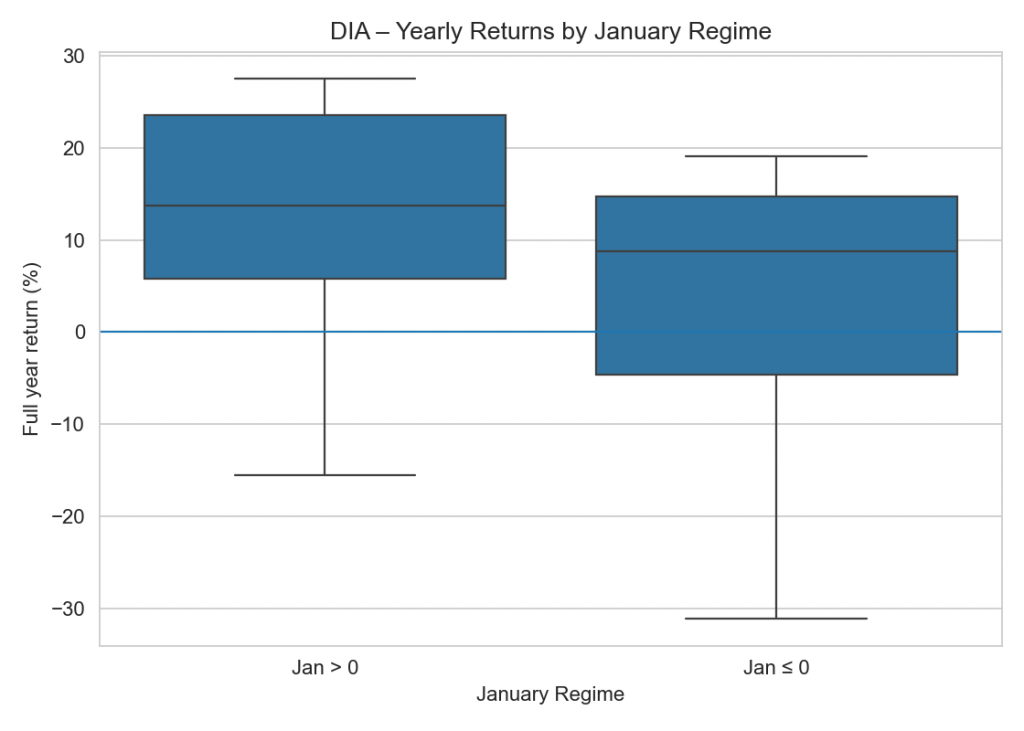
    # 2) Boxplot
    fig = plt.figure(figsize=(7, 5))
    sns.boxplot(
        x=df["JanPos"].map({True: "Jan > 0", False: "Jan ≤ 0"}),
        y=df["YearRet"] * 100
    )
    plt.axhline(0, linewidth=1)
    plt.xlabel("January Regime")
    plt.ylabel("Full year return (%)")
    plt.title(f"{ticker} – Yearly Returns by January Regime")
    plt.tight_layout()
    fig.savefig(os.path.join(save_dir, f"{ticker}_02_boxplot.png"), dpi=160)
    plt.close(fig)

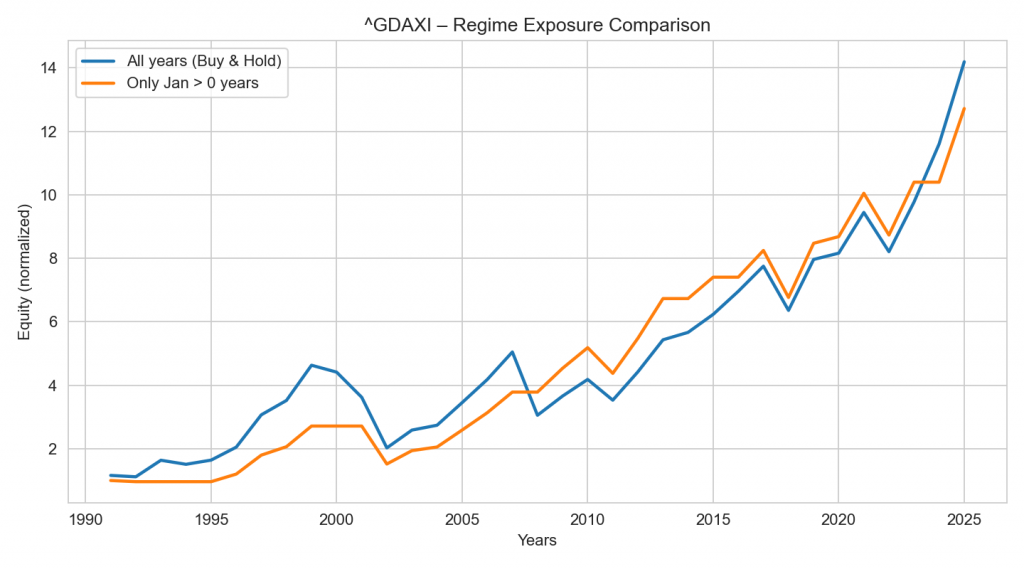
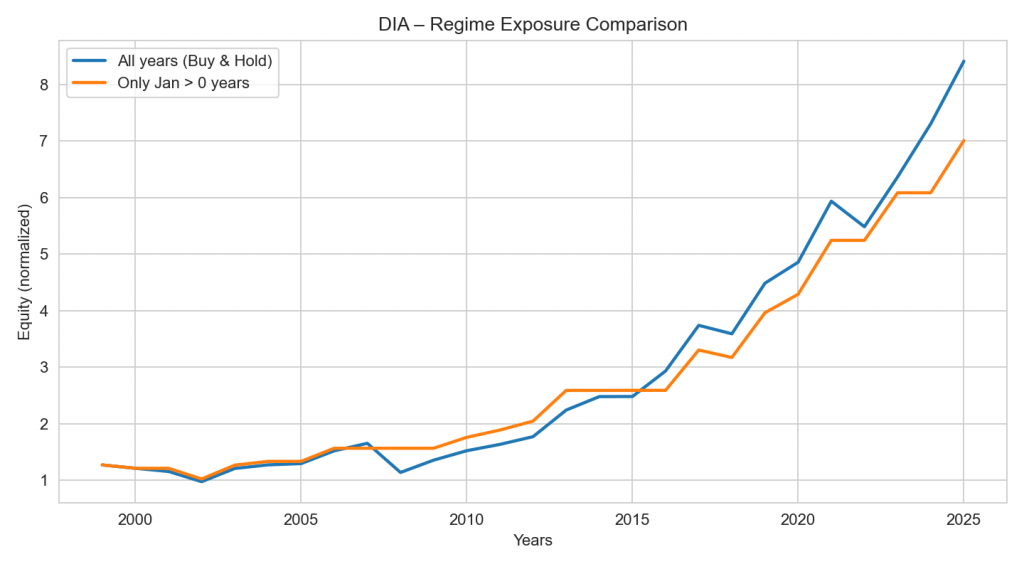
    # 3) Equity-style
    equity_all = (1 + df["YearRet"]).cumprod()
    equity_jan_pos = (1 + df["YearRet"].where(df["JanPos"], 0)).cumprod()

    fig = plt.figure(figsize=(9, 5))
    plt.plot(df.index, equity_all.values, linewidth=2, label="All years (Buy & Hold)")
    plt.plot(df.index, equity_jan_pos.values, linewidth=2, label="Only Jan > 0 years")
    plt.legend()
    plt.title(f"{ticker} – Regime Exposure Comparison")
    plt.ylabel("Equity (normalized)")
    plt.xlabel("Years")
    plt.tight_layout()
    fig.savefig(os.path.join(save_dir, f"{ticker}_03_equity.png"), dpi=160)
    plt.close(fig)


def download_close_series(ticker: str) -> pd.Series:
    df = yf.download(ticker, start=START, end=END, auto_adjust=True, progress=False)

    if df is None or df.empty:
        raise ValueError(f"No data returned for {ticker}.")

    # yfinance returns columns like Open/High/Low/Close/Volume
    # Ensure Close is a Series (not a DataFrame)
    close = df["Close"]
    if isinstance(close, pd.DataFrame):
        # If something weird happens, take first column
        close = close.iloc[:, 0]

    close = close.dropna()
    close.name = "Close"
    return close


def compute_year_table(close: pd.Series, n: int) -> pd.DataFrame:
    s = close.dropna().copy()
    s = s.sort_index()

    years = sorted(s.index.year.unique())
    rows = []

    for y in years:
        s_y = s[s.index.year == y]
        if s_y.empty:
            continue

        # January subset
        s_jan = s_y[s_y.index.month == 1]
        if len(s_jan) < n:
            continue

        jan_first_date = s_jan.index[0]        # Timestamp
        jan_n_date     = s_jan.index[n - 1]    # Timestamp

        # previous trading day close before first January trading day
        # robust approach: locate position via integer location
        pos_first = s.index.get_loc(jan_first_date)
        if isinstance(pos_first, slice) or isinstance(pos_first, np.ndarray):
            # extremely rare, but handle duplicates defensively
            pos_first = pos_first.start if isinstance(pos_first, slice) else int(pos_first[0])

        if pos_first == 0:
            continue

        prev_close = float(s.iloc[pos_first - 1])
        jan_n_close = float(s.loc[jan_n_date])

        jan_ret = jan_n_close / prev_close - 1.0

        # full-year return: first close of year to last close of year
        year_ret = float(s_y.iloc[-1] / s_y.iloc[0] - 1.0)

        rows.append({
            "Year": y,
            "JanRet": jan_ret,
            "YearRet": year_ret,
            "JanPos": jan_ret > 0,
            "YearPos": year_ret > 0
        })

    df = pd.DataFrame(rows)
    if df.empty:
        raise ValueError("No valid yearly rows found. Check start date / data.")
    return df.set_index("Year")


def summarize(df: pd.DataFrame, bootstrap_iters: int = 10000, seed: int = 42) -> dict:
    pos = df[df["JanPos"]]
    neg = df[~df["JanPos"]]

    out = {}
    out["Years"] = len(df)

    out["HitRate_Pos"] = float(pos["YearPos"].mean()) if len(pos) else np.nan
    out["HitRate_Neg"] = float(neg["YearPos"].mean()) if len(neg) else np.nan

    out["MeanYear_Pos"] = float(pos["YearRet"].mean()) if len(pos) else np.nan
    out["MeanYear_Neg"] = float(neg["YearRet"].mean()) if len(neg) else np.nan
    out["Diff_PosMinusNeg"] = out["MeanYear_Pos"] - out["MeanYear_Neg"]

    out["Corr_Jan_Year"] = float(df["JanRet"].corr(df["YearRet"]))

    # Welch t-test (optional)
    if HAS_SCIPY and len(pos) >= 2 and len(neg) >= 2:
        t, p = stats.ttest_ind(pos["YearRet"], neg["YearRet"], equal_var=False, nan_policy="omit")
        out["Welch_pvalue"] = float(p)
    else:
        out["Welch_pvalue"] = np.nan

    # Bootstrap CI for diff of means
    if len(pos) and len(neg):
        rng = np.random.default_rng(seed)
        pos_vals = pos["YearRet"].to_numpy()
        neg_vals = neg["YearRet"].to_numpy()
        diffs = np.empty(bootstrap_iters, dtype=float)
        for i in range(bootstrap_iters):
            diffs[i] = rng.choice(pos_vals, size=len(pos_vals), replace=True).mean() - \
                       rng.choice(neg_vals, size=len(neg_vals), replace=True).mean()
        out["CI_2.5"] = float(np.percentile(diffs, 2.5))
        out["CI_97.5"] = float(np.percentile(diffs, 97.5))
    else:
        out["CI_2.5"] = np.nan
        out["CI_97.5"] = np.nan

    return out


def pct(x):
    return "n/a" if pd.isna(x) else f"{100*x:,.2f}%"

def run():
    print(f"Settings: N_JAN={N_JAN}, START={START}, tickers={TICKERS}")

    for ticker in TICKERS:
        print("\n" + "=" * 90)
        print(f"{ticker}  |  First {N_JAN} trading days of January")
        print("=" * 90)

        close = download_close_series(ticker)
        year_table = compute_year_table(close, N_JAN)

        stats_out = summarize(year_table, BOOTSTRAP_ITERS, SEED)

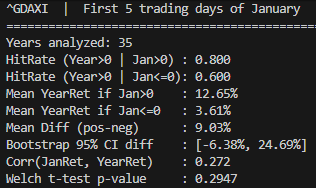
        print(f"Years analyzed: {stats_out['Years']}")
        print(f"HitRate (Year>0 | Jan>0) : {stats_out['HitRate_Pos']:.3f}")
        print(f"HitRate (Year>0 | Jan<=0): {stats_out['HitRate_Neg']:.3f}")

        print(f"Mean YearRet if Jan>0    : {pct(stats_out['MeanYear_Pos'])}")
        print(f"Mean YearRet if Jan<=0   : {pct(stats_out['MeanYear_Neg'])}")
        print(f"Mean Diff (pos-neg)      : {pct(stats_out['Diff_PosMinusNeg'])}")
        print(f"Bootstrap 95% CI diff    : [{pct(stats_out['CI_2.5'])}, {pct(stats_out['CI_97.5'])}]")

        print(f"Corr(JanRet, YearRet)    : {stats_out['Corr_Jan_Year']:.3f}")
        if not pd.isna(stats_out["Welch_pvalue"]):
            print(f"Welch t-test p-value     : {stats_out['Welch_pvalue']:.4f}")

        print("\nLast 8 years:")
        tail = year_table.tail(8).copy()
        tail["JanRet"] = tail["JanRet"].map(pct)
        tail["YearRet"] = tail["YearRet"].map(pct)
        print(tail[["JanRet", "YearRet", "JanPos", "YearPos"]].to_string())

        # 🔥 HIER die Plots
        plot_jan_effect(year_table, ticker, N_JAN)

if __name__ == "__main__":
    run()